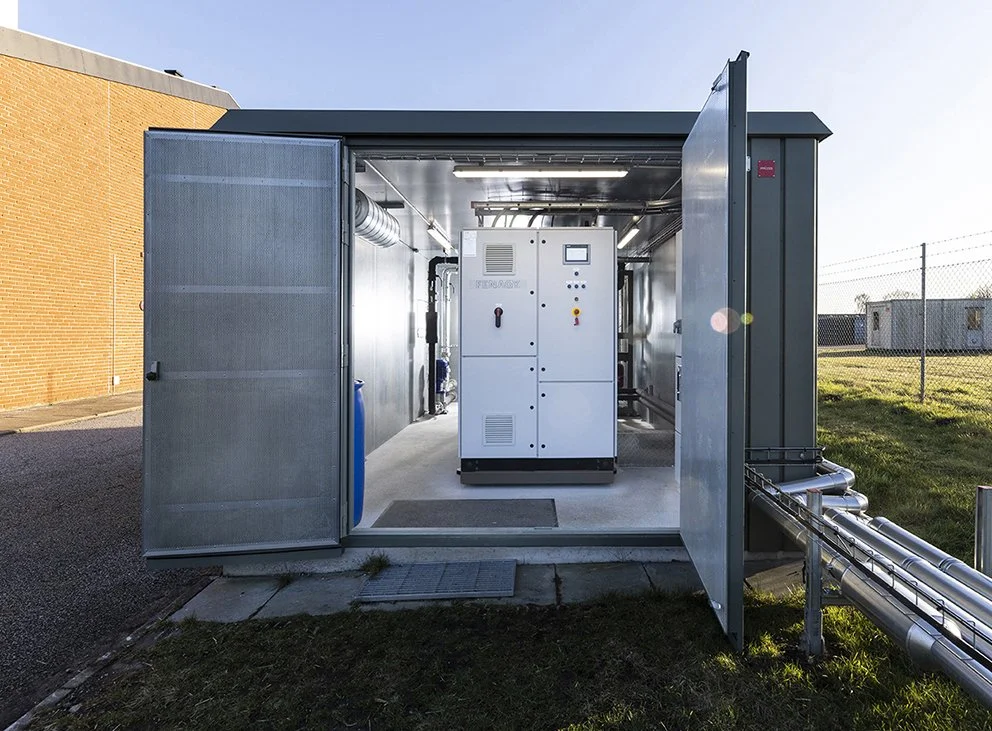
IN SHORT
• An industrial heat pump can be financially attractive if, for example, the waste heat source is available at a minimum of 50 °C, the process consumption has a minimum heat demand of 500 kW, and the annual operating hours are at least 4,000.
• Grants can significantly reduce the net investment, depending on the chosen scheme, configuration, and applicable combination rules. Applications must be submitted before the installation begins.
• The average payback period is 4 to 10 years with a COP of 3 to 5 and a gas price of €0.40 to €0.60 per m³. A shorter payback period is realistic with higher energy prices or a greater heat demand.
An industrial heat pump operates on the same principle as a domestic heat pump, but on a completely different scale and with different refrigerants. The machine extracts heat from a source, such as waste heat, process water, or ambient air, and transfers it via a compressor to the desired process level.
Source temperature, supply temperature, and temperature lift together determine the applicability of a heat pump:
R290 (propane):Source temperature up to -30 °C, supply temperature up to 75 °C, temperature lift > 5 KR744 (CO₂): Source temperature up to -20 °C, supply temperature up to 85 °C, temperature lift > 20 KR600a (isobutane):Source temperature up to 15 °C, supply temperature up to 95 °C, temperature lift > 5 K
• R717 (NH₃): Source temperature up to -10 °C, supply temperature up to 95 °C, temperature lift > 5 K
Cascade configurations with two refrigerant circuits for high temperatures, up to above 120 °C including steam: suitable for steam production and chemical processes, among others. For example, with R717, R718, or R600a.
For large industrial installations, ammonia (NH₃) is the most efficient refrigerant. CO₂ (R744) is suitable for high-temperature applications with a large temperature lift. R290 performs optimally at a low supply temperature. R600a is a well-suited refrigerant for upgrading available low-grade waste heat to high-grade heat. Cascade configurations, for example with R717, achieve output temperatures that a single circuit cannot reach. Nijssen collaborates with Fenagy for various applications.
Heat sources are process-specific: waste heat from the company's own cooling system, process water, ventilation air, or ambient air. The quality of the source largely determines how well the investment pays off.
The three parameters below collectively determine whether the business case is realistic.
Parameter 1 — Source temperature, desired supply temperature, and refrigerant choice
The source temperature, desired supply temperature, and refrigerant choice are the most critical factors. Each refrigerant performs differently at various source and supply temperatures. It is important to have a clear understanding of these temperatures to select the correct refrigerant and reliably determine the annual efficiency.
Parameter 2 — Heat demand and operating hours
For a heat demand below 500 kW, combined with fewer than 3,000 operating hours per year, a payback period under seven years is rarely realistic. The fixed costs for engineering, installation, and maintenance are then relatively high compared to the annual savings.
Above 1 MW thermal capacity and 5,000 operating hours per year, the picture changes rapidly. The annual gas savings are then sufficient to recoup the investment in four to six years, even without subsidies.
Parameter 3 — Gas price and CO₂ price
With a gas price of €0.40 per m³ and an EU ETS CO₂ levy of €65 per ton, as a reference level for 2025, a COP of 3 is already competitive with direct gas heating. At a gas price of €0.60 per m³, for example during peak periods, the payback period can be less than four years. Nijssen will provide a project-specific calculation for your situation.
These schemes can reduce the net investment, but the combination rules are strict. Below are the key points for each scheme.
ISDE — Investment Grant for Sustainable Energy
Commercial heat pumps with a minimum capacity of 100 kW are eligible for ISDE. The subsidy amount depends on the type of installation and the category code on the RVO notification code list. In 2026, a budget of €500 million is available. Applications must be submitted before or at the start of the installation. Source: rvo.nl/isde.
The Investment Grant for Sustainable Energy and Energy Saving (ISDE) includes assets that are also on the Energy List. An asset cannot be eligible for both schemes. If you receive ISDE subsidy for an asset, you cannot apply for EIA for that same asset.
EIA — Energy Investment Allowance
EIA provides a 40 percent tax deduction on investment costs for investments listed on the Energy List. Registration must take place within three months of order confirmation. Source: rvo.nl/eia.
The Investment Grant for Sustainable Energy and Energy Saving (ISDE) includes assets that are also on the Energy List. An asset cannot be eligible for both schemes. If you receive ISDE subsidy for an asset, you cannot apply for EIA for that same asset.
SDE++ — Incentive Scheme for Sustainable Energy Production
SDE++ is a production subsidy per generated gigajoule of useful heat. The scheme is practically relevant for installations above 1 MW and runs for 12 to 15 years. RVO opens the scheme once a year. Source: rvo.nl/sde.
Subsidy amounts are reviewed annually. Check rvo.nl for current rates before submitting your application.
Combining the Energy Investment Allowance (EIA) and SDE++ for the exact same asset is not legally permitted. You will receive either the operational subsidy from SDE++ or the tax benefit from EIA.
In practice, the schemes can complement each other in the following ways:
• For different measures: for a large installation, for example, you can apply for SDE++ for energy generation and also use EIA for other, separate energy-saving measures within your business premises, such as LED lighting or insulation.
The model below is based on a fictitious but realistic food company. The figures are illustrative. The actual payback period depends on the waste heat profile, the electricity contract, the subsidy allocation, and maintenance costs.
Situation
• Heat demand: 800 kW thermal, 5,500 operating hours per year, or 4,400 MWh per year.
• Current situation: natural gas boiler, gas consumption 1.5 million m³ per year as total business consumption.
• Heat pump: NH₃, COP 4, waste heat source from own cooling installation at 35 °C.
Step 1 — Investment Costs
Gross investment: €1.0 million.
Step 2 — Subsidies
• EIA tax deduction effect: 40% × €1.0 million × 25% effective corporate tax rate = €100,000.
• Net investment after subsidies: €900,000.
Please note: these subsidies cannot always be combined.
• You may not combine the EIA with the Environmental Investment Allowance (MIA) for the same investment amount.
• You may not combine the EIA with the Investment Subsidy for Sustainable Energy (ISDE). The ISDE scheme includes assets
that are also on the Energy List. An asset cannot qualify for both schemes. If you receive ISDE subsidy for an asset, you may not submit an EIA application for that same asset.
Step 3 — Annual Energy Savings
The heat pump replaces gas heating for the 4,400 MWh heat demand. This saves approximately 500,000 m³ of natural gas per year. At €0.50 per m³, including a CO₂ surcharge at 2025 levels, this results in an annual gas saving of €250,000.
Step 4 — Payback Period
Simplified, excluding electricity costs: €900,000 / €250,000 = 3.6 years.
The actual payback period is longer due to the heat pump's electricity consumption. With a COP of 4, the system consumes 1,100 MWh of electricity per year. At €0.14 per kWh, indicative and dependent on the business all-in rate including grid costs and energy tax, this amounts to €154,000 in additional electricity costs.
The net annual saving then amounts to €96,000, with an adjusted payback period of 9.5 years. With higher gas prices, for example €0.60 per m³, the adjusted payback period decreases to 6 to 7 years. Nijssen will provide a precise calculation for your situation based on your energy contract and waste heat profile.
Lorem ipsum dolor sit amet, consectetur adipiscing elit, sed do eiusmod tempor incididunt ut labore et dolore magna aliqua. Ut enim ad minim veniam, quis nostrud exercitation ullamco laboris nisi ut aliquip ex ea commodo consequat. Duis aute irure dolor in reprehenderit in voluptate velit esse cillum dolore eu fugiat nulla pariatur.
Block quote
Ordered list
Bold text
Emphasis
Superscript
Subscript
High-temperature heat pumps achieve steam temperatures up to 140 to 160°C via an ammonia-pentane cascade (such as Fenagy technology). For process temperatures below 90°C, an NH3 heat pump is sufficient. Direct replacement requires a process audit, especially for peak loads that the heat pump alone cannot handle. A hybrid configuration, where the heat pump covers the base load and the boiler handles peaks, is often the most cost-effective solution.
No. A cooling system is not mandatory, but waste heat from an existing cooling system is the most efficient heat source, as the source temperature is consistently higher. Without a waste heat source, the heat pump operates on ambient air or process water, resulting in a lower COP. The combination of a cooling system and a heat pump in a single integrated system is technically feasible and yields the highest overall efficiency.
SDE++ operates with application rounds, twice a year. The application process takes three to six months. Engineering and production take six to twelve months, depending on the installation size. After that, allow for a few weeks for commissioning: the realistic lead time from initial exploration to commissioning is 12 to 18 months. ISDE applications are continuous, but the subsidy budget is finite, and it's first come, first served.
An industrial heat pump is profitable with the right scale, a usable waste heat source, and a sufficiently large heat demand. Subsidies can significantly reduce the net investment, but require attention, timely application, and adherence to applicable combination rules. The decision always requires a customized calculation, as the payback period is highly dependent on your specific energy profile, electricity contract, and subsidy allocation.


Cleaning a climate chamber seems simpler than it is, until the panel coating starts blistering after a few months. The combination of high humidity, feed water, and the specific material

Discover what a climate chamber is, which climate conditions are regulated, and when terms like climate cell, test cell, or growth chamber are used.
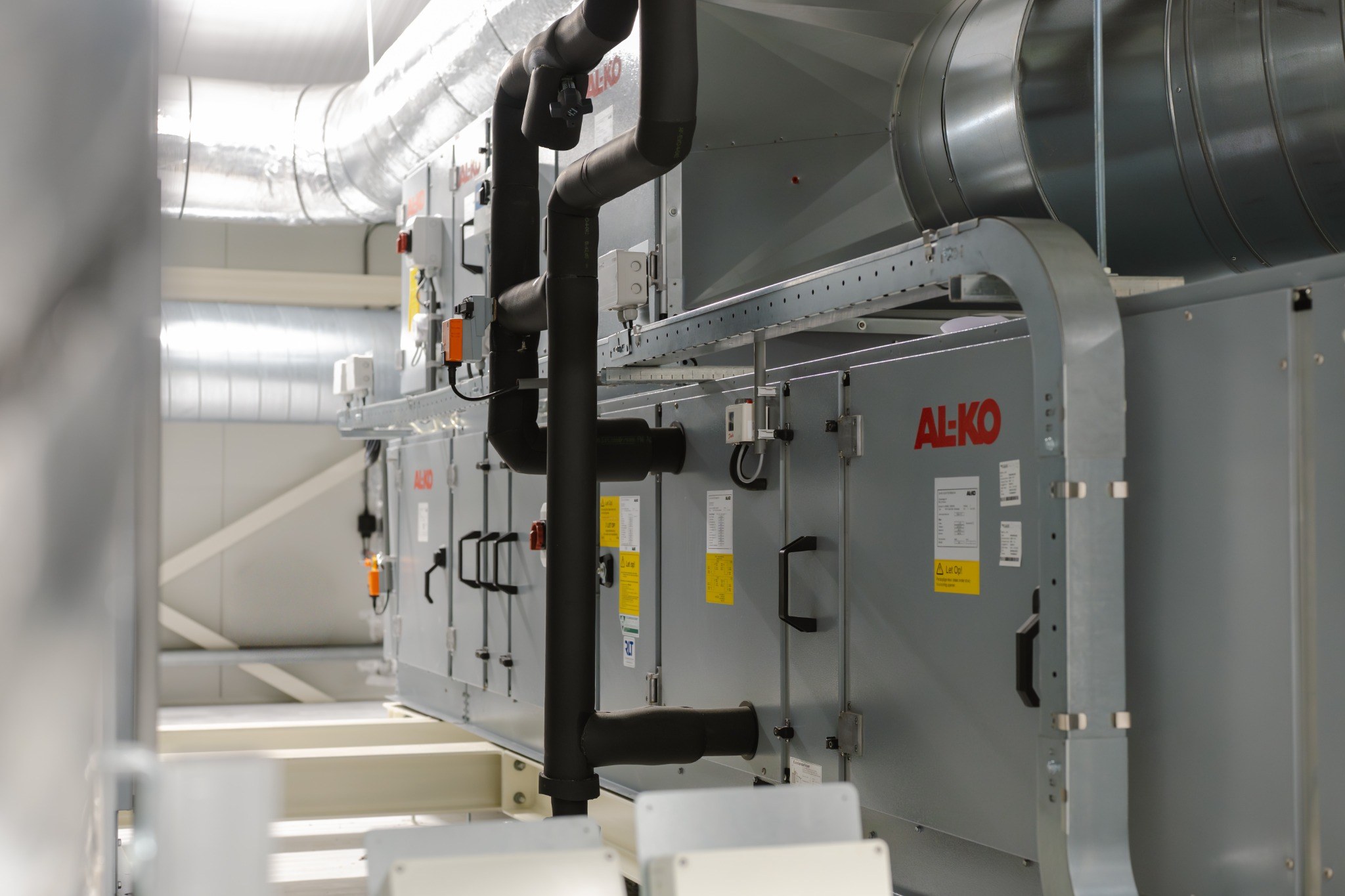
Natural refrigerants are a future-proof alternative to R404A and R507F. This article compares ammonia, CO₂, and propane in terms of cost, safety, and application.
Receive our latest technical publications and project updates directly in your inbox every month.

Lorem ipsum by sit amet, consecteur adipising elite. Suspension tincture of sagittis eros. Quisque quis euismod lorem. Etiam sodales ac felis is interdum.